
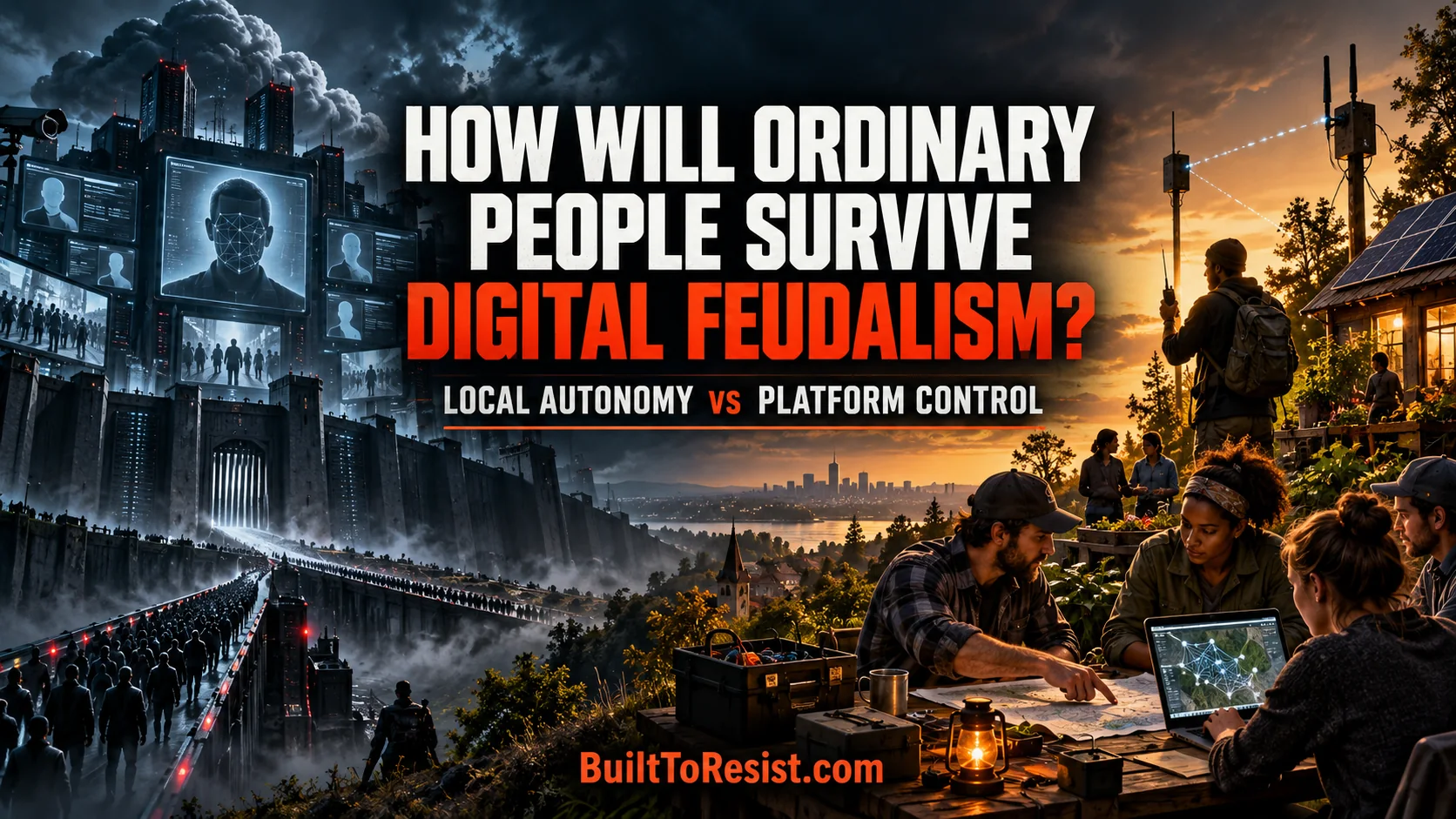
How Will Ordinary People Survive Digital Feudalism?
What if your job, records, software, or community lifelines depend on platforms that can revoke access? Explore practical responses to digital dependency: cognitive liberty, local-first records, cooperative ownership, offline communication, and accountable neighborhood networks. An owner-supplied research video outline, not a transcript.
Watch
Source boundary
This page is based on the publisher’s supplied description and chapter outline. These are editorial statements, not an independently checked video transcript; scenarios and responses vary by locality.
Practical technology guidance requires local verification of legal obligations, availability, equipment safety and service continuity. No YouTube publication timestamp or transcript has been invented.
From the video: five practical questions
What can one provider revoke?
List services that depend on one login, cloud vendor, employer, payment processor or mobile carrier. Save records in exportable formats and test an offline copy.
What can a neighborhood do together?
Identify two trustworthy contacts, a shared resource list, accessible public services and one modest joint project; avoid collecting sensitive personal profiles.
Do cooperative models solve job insecurity?
Shared ownership can change governance and bargaining power, but feasibility, demand, capital, legal obligations and worker safety still matter.
What can mesh and offline tools actually do?
Short-range local messages may help during outages, subject to power, terrain, radio regulations and compatible equipment. They cannot replace clinical care, utilities or the internet at large.
What is a sensible first 90 days?
First audit your key dependencies; next verify local partners and support services; then test one reversible improvement and document what worked.
Chapter guide (publisher-supplied)
Chapter names and times were provided by the publisher. They open YouTube directly at the specified point; actual chapter timing has not been independently checked.
- 00:00 — The New Enclosure: Defining Digital Feudalism — How a single provider can become a point of failure for data, income and daily services.
- 01:30 — The Bunker Fallacy vs. the Sovereign Network — Why trusted networks and shared skills matter more than a fantasy of complete self-sufficiency.
- 03:00 — Pillar 1: Cognitive Liberty & Local-First Computing — Practical ownership of records, exportable data and the ability to question automated decisions.
- 04:45 — Pillar 2: Economic Sovereignty & Worker Cooperatives — Worker ownership, tool libraries and shared purchasing—alongside their real legal and financial constraints.
- 06:15 — Pillar 3: Open Protocols & Mesh Networks — Portable formats and resilient communication options; realistic range, equipment and regulatory limits apply.
- 07:45 — Nonpartisan Governance: Sociocracy & Decentralized Cells — Small accountable groups that cooperate on needs without demanding ideological conformity.
- 09:00 — The 90-Day Execution Blueprint: Audit, Organize, Build — Audit dependencies, verify contacts and begin one small measurable community project.